
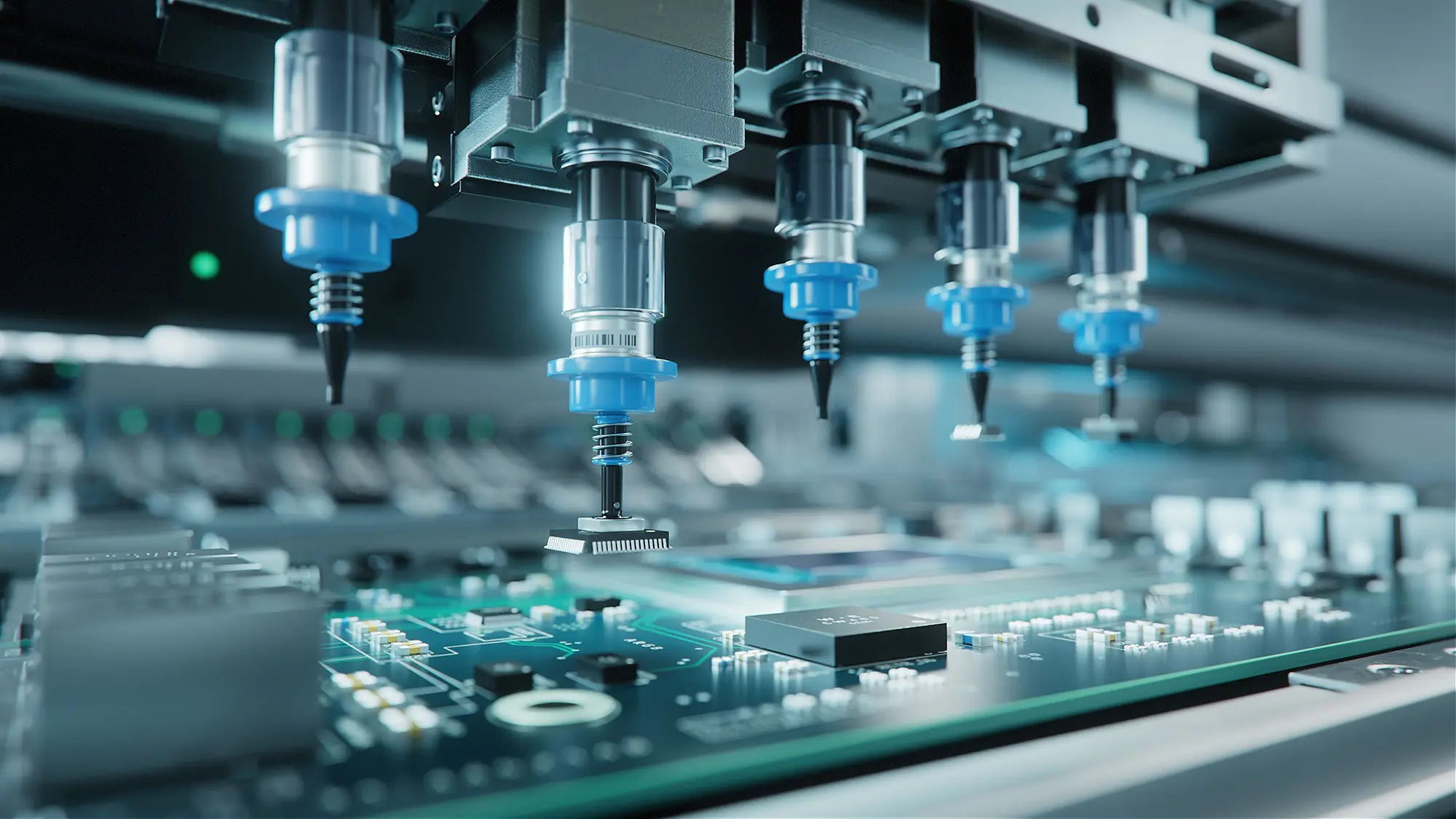
Technical expertise
Technical depth that makes the difference.
Designing complex electronics isn’t just about knowing how to assemble a board: it means mastering hardware, firmware, protocols, regulations, and testing, all at once. Here is the expertise we bring to your project, from circuit diagrams to certification.
Why it matters
Real expertise, not just production capacity
Over forty years of developing regulated products has left us with a wealth of cross-disciplinary skills: we know how to design a safety circuit, write certifiable firmware, choose the right protocol, pass EMC tests, and industrialise for series production. This isn’t theory: it is the daily know-how of our technical department, listed here without filters.
Hardware R&D
Hardware Design
Electronics designed from scratch, for every need.
From analogue signal conditioning to isolated switching power supplies, from safety circuits to motor control: we design the hardware your product requires, using professional development and simulation tools.
- Analogue — signal conditioning and acquisition from sensors, filters, isolated circuits
- Digital — PAL/GAL, combinational logic, microcontrollers, and microprocessors
- User interface — LCD, LED, and dot-matrix displays, capacitive touch
- Power supply (SMPS) — isolated switching mode power supplies, high-voltage step-up
- Motors — single-phase motor control, low-voltage micro/half/full stepper, power motors
- Lighting — LED drivers, power LEDs, smart LEDs
- Sub-GHz RF and LoRa 868 — antenna transceivers and matching
- PCB Design — Altium: schematics, PCBs up to 8 layers, signal integrity, mixed simulation, 3D and mechanical integration
Firmware / Software R&D
Firmware and Software
Reliable code, even where safety is a legal requirement.
We develop firmware up to Class C for gas appliances — the most stringent safety level — and software for industrial and domestic applications, using advanced control algorithms and leading development toolchains.
- Safety code — Class C for gas burner appliances, Class B for industrial and domestic applications
- Languages — C, Assembler, Python
- Controls — PID algorithms (heating/cooling), PWM controls for motors, fans, modulating pumps, and lighting
- Microcontrollers — STM32, RENESAS, MICROCHIP 8/16 bit, ARM devices
- Motors — FOC algorithms for brushless motor management
- Toolchains — E2Studio, STM32CubeIDE, Eclipse, MPLAB X, IAR Workbench, ARM-GCC
- PLC — Siemens TIA Portal
- Versioning — SVN / Git
- Web and services — Node.js (server, web app), Node-RED, remote server, PWA
Mechanical Design
Mechanics and Mechatronics
It’s not just about electronics: we also design the product that houses them.
A mechatronic product isn’t just a circuit board inside any old box: the mechanical and electronic components must be designed together. We develop components and assemblies—metal, plastic, and silicone—all the way to the finished product with high-quality finishes, managing the entire process from concept to mold to mass production.
Design
- Metal, plastic, and silicone components and assemblies
- LCD displays, user interfaces, conductive rubber keypads
- Complete mechatronic products, including those with high-quality aesthetic finishes
- Calculation and simulation · material selection and surface treatments
Mastered manufacturing processes
- Injection molding (draft angles, wall thicknesses, gate locations, shrinkage)
- Die casting
- CNC machining
- Sheet metal: blanking and bending
- Assembly: screws, inserts, clips, ultrasonic welding
- Equipment: assembly and testing jigs, production line equipment
Molds, suppliers, and process quality
- Co-design with mold makers and mold development
- Sample release (FAI / ISIR) and PPAP management or equivalent process
- BOM management and changes using PLM/PDM, revision control, and a structured ECR/ECO process
- Formal design reviews at key stages: concept, pre-mold, release
Documentation and prototyping
- Comprehensive documentation: native and neutral models (STEP), drawings, calculations, and reports
- Rapid prototyping (3D printing, SLA/SLS, milling) for preliminary verification
Connectivity
Communication protocols
Every device, connected the right way.
From industrial safety buses to wireless connectivity for the IoT: we master the protocols needed to make your product communicate in industrial, domestic, and HVAC environments.
- Industrial — RS485 Modbus RTU/ASCII/TCP, CAN Bus, LIN Bus, Ethernet
- Wireless / IoT — LoRa/LoRaWAN, RF Sub-GHz, WiFi/BLE/Mesh/Thread, MQTT
- HVAC and lighting — OpenTherm, DALI/DMX
Compliance
Product regulations
Designing with certification in mind.
Regulatory compliance is not a final check: it is a requirement that guides the project from the start. We have in-depth knowledge of the regulations in the sectors we operate in — from gas to electrical safety, from electromagnetic compatibility to radio frequencies.
- Gas and burners — (EU) 2016/426 (GAR), EN 298, EN 13611, ANSI Z21.10.3 / CSA 4.3
- Electrical safety — UL 60730-1 / CSA E60730-1, CSA/ANSI Z21.20 / CSA C22.2 No. 60730-2-5
- Electromagnetic compatibility — EN IEC 55014, EN IEC 62311
- Radio frequencies (RED) — RED 2014/53/EU, ETSI EN 301 489-17, EN 300 328, EN 303 413
- Other fields — IEC 60335-2-107 (battery-powered robotic lawnmowers)
EMC Testing
Pre-compliance EMC laboratory
An in-house laboratory to validate before certifying.
Having an internal pre-compliance laboratory means identifying and correcting electromagnetic compatibility issues before reaching the certification body — saving time, costs, and redesign cycles.
- EMC Tests — pre-compliance immunity and conducted emission
- GTEM Cell — pre-compliance radiated emission
- Burn-in & Run-in — stress tests and prolonged performance trials
- Climatic chambers — dynamic tests from −40 °C to +180 °C, static chamber up to +300 °C
Process quality
Quality and traceability
Quality is documented data, not a promise.
Every stage of the production process follows rigorous standards: from ESD protection to the traceability of individual components, through to the controlled management of moisture-sensitive components.
- ESD Environment — CEI EN 61340: rigorous electrostatic discharge protection procedures (wrist straps, footwear, coats, and ESD workstations)
- Visual inspection — IPC-A-610: acceptability standards for identifying soldering defects (bridges, cold joints, voids, misalignments)
- IPC-1782 Level 2 Traceability — tray/reel and board tracking, with process parameters and pass/fail test results
- IPC-1782 Level 3 Traceability — tracking of every component batch associated with its position on the board, with full data from every machine on the line (soldering temperature, placement force, AOI data)
- MSL Component Management — IPC/JEDEC J-STD-033: dry cabinets and procedures for components with MSL > 2 classification, from incoming to package depletion
Industrialisation
Industrialisation and testing
From prototype to series production, with custom test benches.
We develop functional test stations and testing programs in-house, with data storage for every board. This is how we ensure that the series production performs exactly like the prototype.
- Test benches — stations for semi-automatic and automatic functional testing
- Test automation — VB.NET programs with data storage on SQL databases
- Spea Systems — programming for 3030, 4050, Easytest, FT1000
- Data management — SQL for storage and consultation of test data
Testing lines
- Flying probes — with automatic loading/unloading line, for parametric and powered tests on pre-series and low volumes
- Dual Bay Bed-of-Nails — with automatic loading/unloading line, for simultaneous parametric and functional testing of two boards
Artificial intelligence
Artificial intelligence supporting engineering
Advanced tools, always guided by human expertise.
We integrate artificial intelligence into our workflow as a productivity tool for the technical department, not as a replacement for engineering expertise. AI helps us accelerate repetitive tasks, analyse complex codebases, and produce documentation more quickly, while every technical decision, design choice, and validation remains in the hands of our engineers.
- Development productivity — support for refactoring, structural project management, and documentation drafting
- Code analysis — understanding extensive codebases and the context of entire projects to identify critical issues more quickly
- Logic design support — analysis of complex issues to support the work of engineers
certification
The bodies we collaborate with
We work alongside the leading international certification bodies, so your product reaches the market compliant and ready.
Partner Certification Bodies







ISO 9001:2015
Quality Management System
Ensures efficiency, continuous improvement, and optimisation of the workflow from design to final testing.
ISO 14001
Environmental Management
Certifies the continuous pursuit of production solutions with reduced environmental impact, in full compliance with WEEE disposal.
IPC-A-600 / 610
Trained Technical Staff
Establishes the standard for the quality and acceptability of electronic assemblies. All our staff undergo continuous certification courses.
Speak with the technical department
Do you have a project that requires this level of expertise?
Tell us what you are developing: our technical department will know how to approach it, from the schematic to certification.
Speak to our team
Contact Us
Do you have a project you’d like to develop or a technical inquiry? Our specialists are here to help you find the best solution for your needs.
CAREER OPPORTUNITIES
Join the team
Are you looking for a new professional challenge? Join our team and help us bring innovative projects to life.